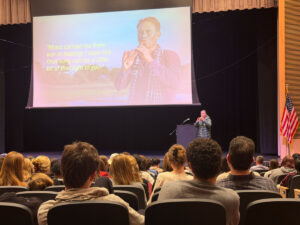
 One of 12 children born into a family of musicians and artists, Arn Chorn-Pond was only 11 years old when the brutal Khmer Rouge came to power in Cambodia. He loved rock ‘n roll music and American ice cream, loves that quickly became liabilities under a regime where admitting affection for anything American could get one killed.
In early October, Chorn-Pond traveled 25,000 miles to share his experiences with students at Arlington High School during a program held as part of Civics and Constitution Day. Facilitated by AHS history teacher Melanie Konstandakis and Arlington Public Schools Performing Arts Director Jing-Huey Wei, his visit to AHS was funded in part by a $4,000 Innovations in Education grant from Arlington Education Foundation.
Separated from his parents and forced, along with 700 other children from his local area, into a labor camp, Chorn-Pond spent the next four years trying to survive. He was compelled to play propaganda songs on his flute while he watched his younger brother and sister starve to death, and many of his friends murdered. In all, 24 members of Chorn-Pond’s family were among the estimated 2 million Cambodians slaughtered by the Khmer Rouge between 1975 and 1979.
Over the course of an hour, Chorn-Pond shared his story with students, played several songs on his flute, and even put some of his dance moves on display. He continually emphasized to students the ways in which they were similar: “I grew up on hamburgers like you. I can care like you,” he said, adding that what he endured in Cambodia can happen anywhere and encouraging students to show kindness to one another. “If we don’t pay attention, things can happen,” Chorn-Pond said. “It’s very important that we respect and care for each other.”
“Genocides thrive when there aren’t strong democracies,” Michael Kozuch, APS Director of History and Social Studies, told students. Other activities during the day were designed to educate students about local representative government, and the League of Women Voters was on hand to help eligible students register to vote. Chorn-Pond’s presentation was open to all classes held during C block at the high school, and students in a majority of history classes, along with several World Language, English and a couple of math classes attended, Konstandakis said.
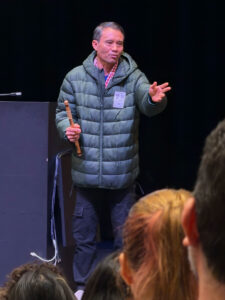 Students benefit from hearing survivors’ share their direct experiences of world events they learn about in the classroom, Konstandakis said. “It is far more powerful than hearing second- or third-hand accounts because a survivor can share in a way that allows a student to connect to their humanity,” she said. “My students told me how they felt watching Mr. Chorn-Pond’s face when he spoke or when they watched his muscles tense as he talked about the cruelty he experienced. … When they watch him smile or laugh or have the chance to hug him, they see that there is hope after trauma and that people can endure and find a way forward after the unimaginable.”
AHS also held a separate evening event open to the community, where Chorn-Pond performed with the AHS Jazz Combo, improvising together on a simple Cambodian song that is sung when people gather together joyfully. Performing Arts Director Wei said students felt inspired by the collaboration. “It was apparent that they enjoyed playing with each other, and it brought so much joy to the audience,” she said. Both she and Konstandakis expressed their gratitude to AEF for making Chorn-Pond’s visit possible.
These events are just one example of the many ways AEF seeks to help APS educators bring their creative ideas to life in ways that benefit students from across the district in the classroom and beyond. AEF is currently accepting applications for its fall round of Excellence in Education grants, formerly known as Innovations in Education grants. The deadline to submit an application is Nov. 1. For more information, log onto https://www.aefma.org/excellence-in-education-grants/.